What Happens If I Miss the Tax Self Assessment Deadline of 31 January?
By the PRS Smart Accountants tax team · Updated November 2026 · 9-minute read
If you miss the Self Assessment deadline of 31 January, HMRC charges an automatic £100 penalty straight away, and the cost keeps rising the longer your return is late. If you also haven't paid your tax bill, interest starts the very next day, and late payment penalties follow after 30 days.
Each year around a million people miss the 31 January Self Assessment deadline, so you are far from alone. The good news is that it is fixable, and acting quickly makes a big difference to what you end up paying. In this guide, the tax team at PRS Smart Accountants answers the question we hear every February: "What happens if I miss the tax Self Assessment deadline of 31 January?"
Key dates for the 2025/26 tax year: the paper return deadline was 31 October 2026. The online Self Assessment deadline is midnight on Sunday 31 January 2027. Any tax owed, plus your first payment on account for 2026/27, is due the same day.
What happens if I miss the Self Assessment deadline? The quick answer
Here is what happens, in order, if you miss the 31 January Self Assessment deadline:
- 1 day late: an automatic £100 late filing penalty, even if you owe no tax or have already paid.
- From 1 February: interest on any unpaid tax, currently 8% a year.
- 30 days late: a 5% late payment penalty on any tax still unpaid.
- 3 months late: £10 a day for up to 90 days, a maximum of £900.
- 6 months late: a further filing penalty of £300 or 5% of the tax due, whichever is higher, plus another 5% late payment penalty.
- 12 months late: another £300 or 5% filing penalty (more if HMRC thinks you deliberately withheld information), plus a third 5% late payment penalty.
Filing and paying are treated separately. You can be penalised for one, the other, or both, which is why missing the Self Assessment deadline can become expensive very quickly.
Late filing penalties if you miss the Self Assessment deadline
Late filing penalties are charged because your tax return is late, not because you owe tax. That surprises many people: you can owe nothing, or even be due a refund, and still receive a £100 fine for missing the Self Assessment deadline.
| How late your return is | Penalty |
|---|---|
| 1 day late | £100 fixed penalty |
| 3 months late | £10 a day for up to 90 days (maximum £900) |
| 6 months late | £300 or 5% of the tax due, whichever is higher |
| 12 months late | £300 or 5% of the tax due, whichever is higher (up to 100% in serious cases) |
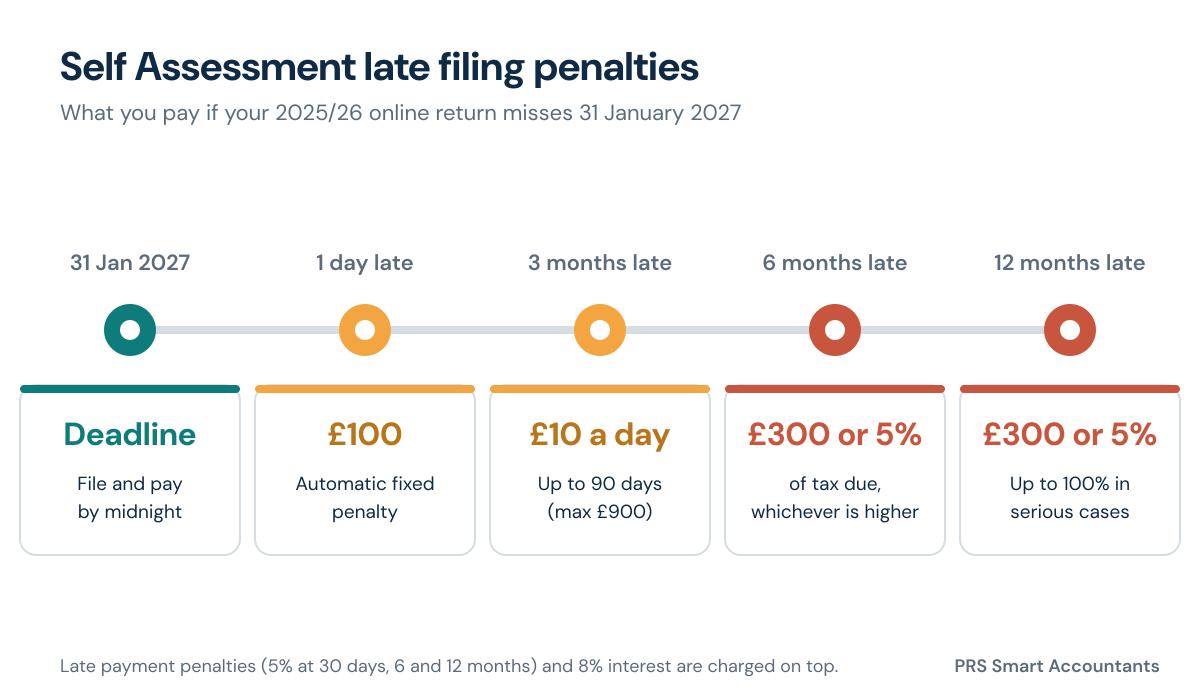
These are the penalties set out by HMRC on GOV.UK's Self Assessment penalties page. If your 2025/26 return is still missing on 31 July 2027, you could already face £1,300 in filing penalties alone, before any tax, interest or late payment charges.
Do I still get a penalty if I don't owe any tax?
Yes. The £100 penalty applies whenever HMRC sent you a notice to file and your return arrives late. If you no longer need to complete a tax return, for example because you stopped self-employment, ask HMRC to cancel the requirement to file as early as possible. HMRC can then withdraw the notice and any penalty.
What if I registered for Self Assessment late?
Your filing deadline depends on when HMRC issued your notice to file. If it was sent after 31 October 2026, you normally have 3 months from the date of the notice. However, the tax payment deadline is still 31 January 2027, so interest and late payment penalties can apply even when the filing penalty does not. The charity LITRG explains these special cases in plain English.
Is the deadline different for paper returns?
Yes. Paper returns for 2025/26 were due by 31 October 2026. If you missed that date, file online by 31 January 2027 and you will avoid a late filing penalty altogether. Our team can file your Self Assessment tax return online for you.
Late payment penalties and interest if you miss the Self Assessment deadline
If you miss the Self Assessment deadline for paying your tax, HMRC adds interest from the first day and penalties from day 31. These charges sit on top of any late filing penalties.
Late payment penalties for the 2025/26 tax year
| Tax still unpaid | Penalty |
|---|---|
| 30 days after 31 January | 5% of the unpaid tax |
| 6 months after 31 January | A further 5% of the tax still unpaid |
| 12 months after 31 January | A further 5% of the tax still unpaid |
Late payment penalties apply to your balancing payment, not to payments on account. Payments on account paid late still attract interest, though. You can estimate your own figures with HMRC's Self Assessment penalty calculator.
How much interest does HMRC charge on late tax?
HMRC charges late payment interest at the Bank of England base rate plus 4%. After the base rate rose to 4.00% on 5 November 2026, the rate became 8% a year from 24 November 2026. Interest runs daily from 1 February until you pay in full. It also applies to unpaid penalties. Check the current figure on GOV.UK's HMRC interest rates page.
Worked example: what missing the Self Assessment deadline could cost
Sam, a self-employed graphic designer, owes £4,000 for 2025/26. Sam misses the 31 January 2027 Self Assessment deadline, then files and pays on 1 August 2027, about six months late.
| Charge | Amount |
|---|---|
| Initial late filing penalty | £100 |
| Daily penalties (90 days × £10) | £900 |
| 6-month late filing penalty (£300 is higher than 5% of £4,000) | £300 |
| Late payment penalty at 30 days (5%) | £200 |
| Late payment penalty at 6 months (5%) | £200 |
| Interest at 8% for 181 days (approx.) | £159 |
| Total extra cost | £1,859 |
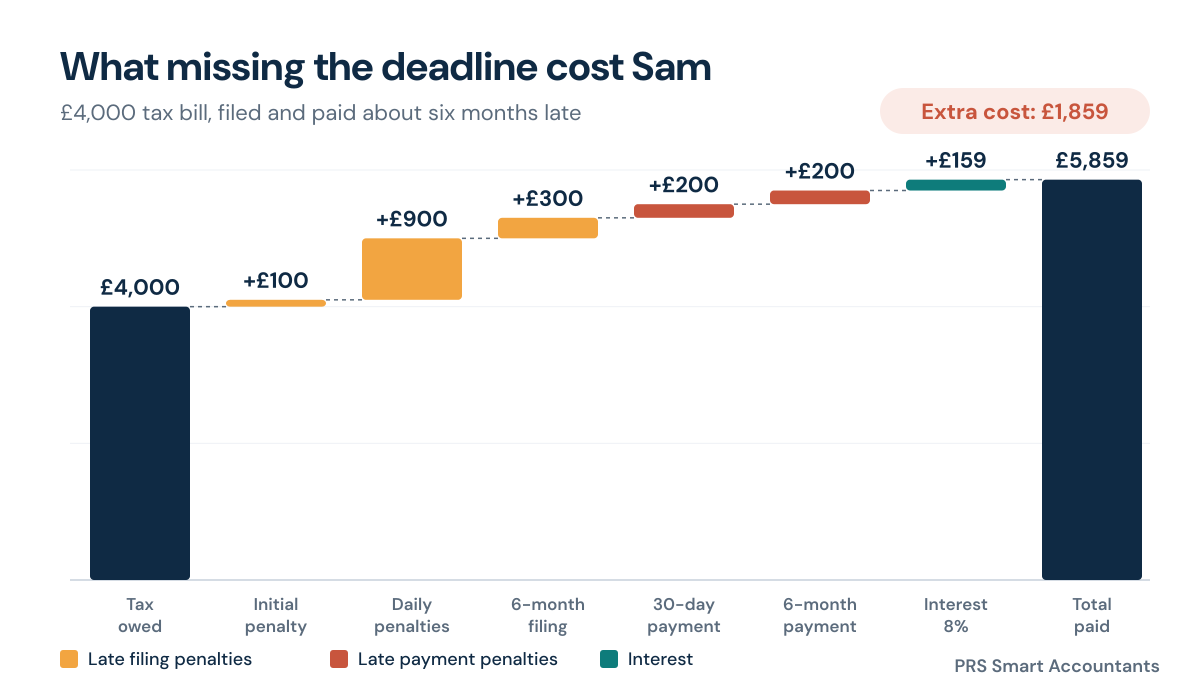
Sam ends up paying almost 50% more than the original tax bill. Had Sam filed on time and simply paid late, the extra cost would have been far lower. This assumes the interest rate stays at 8%; interest on the penalties themselves would add a little more.
Are late payment penalties changing?
Yes, but not for the 31 January 2027 deadline. From 6 April 2027 (the 2027/28 tax year), all Self Assessment taxpayers move to a new penalty system with late filing points and percentage-based late payment penalties. The ICAEW's summary of the Autumn Budget 2025 and the ICAS guide to which penalty regime applies both confirm that the current rules still apply to 2025/26 returns.
I've missed the Self Assessment deadline. What should I do now?
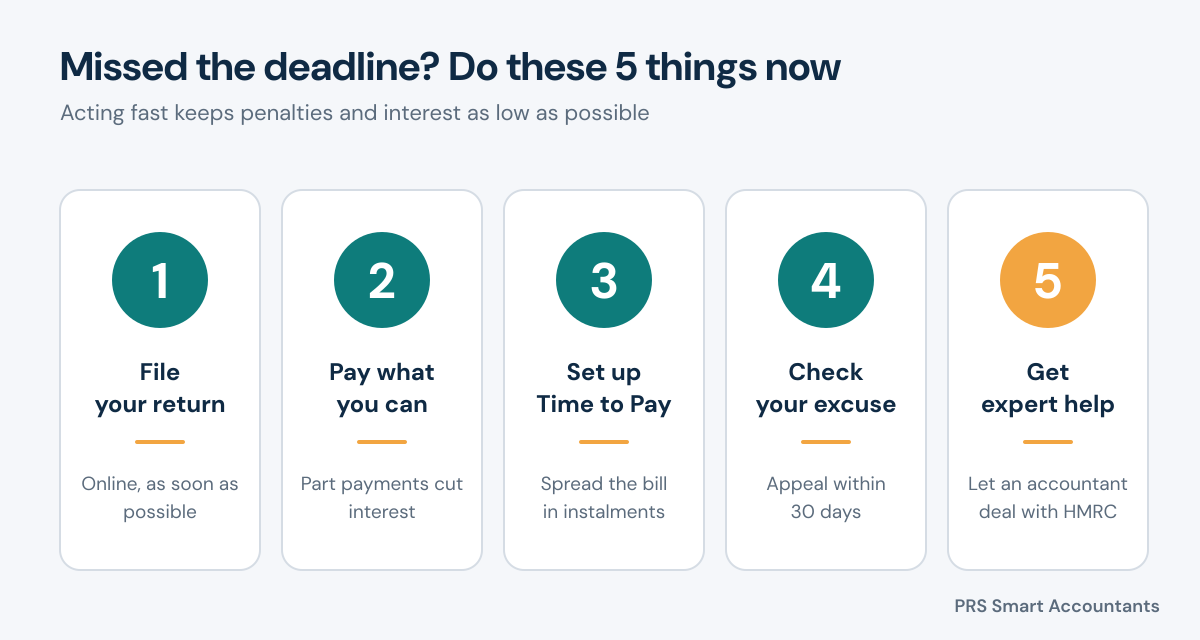
File your return as soon as possible, then pay what you can. Every day you wait after the 31 January Self Assessment deadline can add to the bill, so speed matters more than perfection. Follow these five steps.
- File your return immediately. Use your HMRC online account. Filing within three months stops the penalty at £100.
- Pay what you can. Even a part payment reduces interest and future penalties. See the ways to pay your Self Assessment tax bill.
- Set up a payment plan if you can't pay in full. HMRC's Time to Pay arrangement is covered below.
- Check for a reasonable excuse. If something outside your control stopped you, appeal the penalty.
- Get help early. An accountant can often file within days and deal with HMRC for you. Talk to our Self Assessment team.
Can I appeal a late Self Assessment penalty?
Yes, if you have a reasonable excuse. You normally need to appeal within 30 days of the date on your penalty notice, and you must still file the return. Appeals are worth making when the facts support them. Which? reported that taxpayers won 20,076 of the 32,258 penalty appeals HMRC received between 31 March and 30 September 2025.
What counts as a reasonable excuse for missing the Self Assessment deadline?
HMRC lists examples of a reasonable excuse on GOV.UK. These include:
- the death of a partner or close relative shortly before the deadline
- an unexpected stay in hospital, or a serious or life-threatening illness
- a computer or software failure while you were preparing your online return
- HMRC's online services failing
- fire, flood or theft that prevented you from filing
- postal delays you could not have predicted
These usually don't count: forgetting, finding the online system difficult, relying on someone else who let you down, or not having the money to pay. Once the excuse ends, you must file without unreasonable delay.
What if I can't afford to pay my tax bill?
File on time anyway, then set up a payment plan. Filing late adds penalties you could easily avoid, even when you can't pay. HMRC's Time to Pay arrangement lets you spread the cost in monthly instalments.
You can usually set up a plan online, without calling HMRC, if you owe £30,000 or less, have filed your latest return, and apply within 60 days of the payment deadline. Interest still applies, but a plan agreed in time stops late payment penalties from being added. If you owe more, or your situation is complicated, PRS Smart Accountants can negotiate with HMRC on your behalf.
Does Making Tax Digital change the 31 January Self Assessment deadline?
Not for 2025/26. Since 6 April 2026, sole traders and landlords with qualifying income over £50,000 must use Making Tax Digital for Income Tax and send quarterly updates. However, their 2025/26 return is still due by 31 January 2027 under the current penalty rules. The qualifying income threshold falls to £30,000 from April 2027 and £20,000 from April 2028.
MTD will add new deadlines through the year, so missed dates will matter more than ever. Our Making Tax Digital service can set up the right software and keep your quarterly updates on track.
How to avoid missing the Self Assessment deadline next year
The easiest way to avoid Self Assessment penalties is to file early. You can file your 2026/27 return from 6 April 2027, which gives you nearly ten months before the deadline. Here is how our clients stay ahead:
- File early. You still don't pay until 31 January, but you know your bill months in advance.
- Keep records all year. Cloud bookkeeping software turns January panic into a quick review.
- Save for your tax bill. Put aside a percentage of every invoice or rent payment in a separate account.
- Plan for payments on account. These can make your first January bill much bigger than expected. Read our guide to payments on account explained.
- Pay through PAYE if eligible. If you owe under £3,000 and file online by 30 December, you may be able to pay through your tax code.
- Hand it to an accountant. A fixed-fee Self Assessment service means someone else watches the dates for you.
Frequently asked questions about missing the Self Assessment deadline
What happens if I miss the Self Assessment deadline by one day?
You receive an automatic £100 late filing penalty. If you owe tax, interest also starts from 1 February. Filing within three months keeps the filing penalty at £100.
Does HMRC give a grace period after 31 January?
No, not normally. HMRC waived penalties for February in some past years, such as during the pandemic, but you should never rely on that. The deadline is midnight on 31 January, even when it falls on a weekend, as it does in 2027.
Can I go to prison for missing the Self Assessment deadline?
No, simply missing the Self Assessment deadline is not a crime. Prosecution is reserved for deliberate tax evasion. Unpaid tax can, however, lead to debt collection and court action, so contact HMRC early if you are struggling.
Will HMRC tell me if I've missed the Self Assessment deadline?
Yes. HMRC will send a penalty notice, usually within a few weeks. Don't wait for it, though: penalties and interest build up whether or not you've heard from HMRC.
Can an accountant file my late tax return for me?
Yes. PRS Smart Accountants regularly files late returns, including returns several years overdue. We gather your records, calculate the tax, file the return and help you appeal any penalties where you have a reasonable excuse.
Missed the 31 January Self Assessment deadline? Let PRS Smart Accountants help
Missing the Self Assessment deadline is stressful, but the sooner you act, the less it costs. Our tax team can file your late return quickly, check whether you can appeal, and arrange a payment plan with HMRC if you need one.
Book a free consultation with PRS Smart Accountants today and get your tax affairs back on track.
This article is general information based on HMRC rules as of November 2026, not personal tax advice. Penalties and interest rates can change, so please speak to an adviser about your circumstances.
More on uk & international tax
Browse our uk & international tax guides or discuss your circumstances with our tax advisory team.
- UK Tax Return deadline and avoid pitfalls
Navigating the complexities of the UK tax return process can be daunting, especially with looming deadlines and the potential for costly mistakes. Understanding the importance of timely filing is crucial for individuals and businesses alike, as missing the deadline can lead to significant penalties and stress. This article aims to provide a comprehensive guide on the UK tax return deadline, highlighting key dates, common pitfalls to avoid, essential documentation needed for a smooth submission,
- A Friendly Guide to Filing Ltd Company Tax Return
Filing a tax return for your limited company might sound daunting at first. But don’t worry - it’s a straightforward process once you know the steps. I’m here to walk you through everything you need to know about filing your Ltd company tax return with confidence. Whether you’re new to running a limited company or just want to make sure you’re doing it right, this guide will help you stay on top of your tax responsibilities.Understanding the Basics of Filing Ltd Company Tax ReturnBefore diving i
- How to prepare your business for UK tax deadlines: a practical checklist
Stay compliant with UK tax deadlines—Self Assessment (Jan 31), Corporation Tax, and quarterly VAT returns—by accurate bookkeeping and planning. PRS Smart Accounting offers expert, fixed-fee support.
- Mastering Your Annual Tax Return: Essential Steps for Stress-Free Filing
Master your annual tax return by organizing records, reviewing income, and understanding deductions. PRS Smart Accounting offers expert advice and bookkeeping for accurate, stress-free filing.